The world is changing faster than ever before, and education is changing with it. Today’s children will enter careers that may not even exist yet. Technologies like Artificial Intelligence (AI), automation, and digital learning are transforming the way students learn and prepare for life.
For parents, this raises an important question:
Is my child learning the skills needed for tomorrow’s world—not just today’s exams?
India’s National Education Policy (NEP) 2020 has already begun reshaping classrooms by encouraging experiential learning, critical thinking, and skill development. At the same time, schools are increasingly focusing on creating confident, adaptable, and responsible learners.
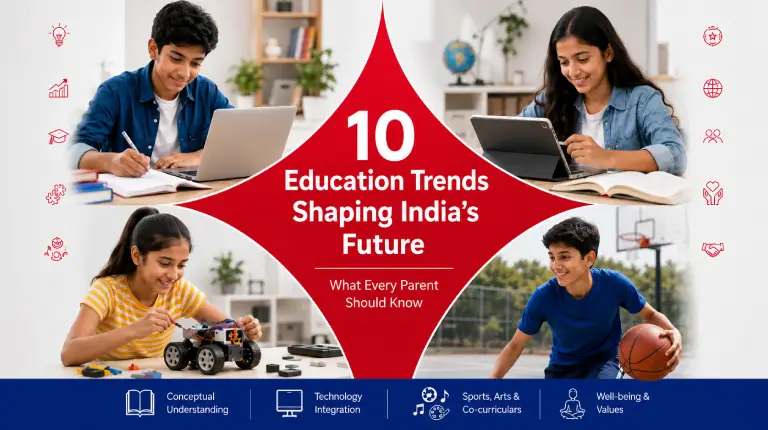
Here are ten major education trends that every parent should understand as they prepare their child for the future.
1. Learning Will Matter More Than Marks
For many years, academic scores were seen as the biggest measure of success. While good grades remain important, they are no longer enough.
Employers today are looking for problem-solvers, communicators, creative thinkers, and team players. Students need to understand concepts, apply knowledge, and think independently.
Schools are gradually moving from rote memorisation to activity-based learning where students learn by exploring, questioning, and doing.
Parents can support this by encouraging curiosity at home instead of focusing only on report cards.
2. Artificial Intelligence Will Become Part of Everyday Learning
Artificial Intelligence is no longer a technology of the future—it is already changing classrooms.
AI-powered learning platforms can personalise lessons, identify learning gaps, and help students learn at their own pace. Teachers can also use AI tools to make lessons more engaging while spending more time guiding students individually.
However, AI is not replacing teachers. Instead, it is becoming a valuable tool that supports better learning experiences.
Schools that introduce children to responsible use of AI are preparing them for future careers where digital skills will be essential.
3. Future Careers Will Demand Continuous Learning
Experts believe that many current jobs will evolve significantly over the next decade due to automation and technological advancements.
This means children cannot depend only on what they learn during school. They must develop the habit of continuous learning throughout life.
Skills like adaptability, curiosity, digital literacy, and critical thinking will become just as important as academic knowledge.
The goal of education is no longer simply earning a degree—it is preparing students to keep learning throughout their careers.
4. Skills Will Become as Important as Academics
Communication, leadership, creativity, emotional intelligence, collaboration, and decision-making are becoming essential life skills.
These abilities help students perform better not only in higher education but also in workplaces and everyday life.
Modern schools are therefore integrating sports, arts, debates, coding, public speaking, and project-based learning into the curriculum to develop well-rounded individuals.
When children participate in diverse activities, they gain confidence and discover their strengths beyond textbooks.
5. Technology Will Make Learning More Personal
Every child learns differently.
Some understand concepts quickly through visuals, while others learn better through practical activities or discussions.
Digital learning tools now allow teachers to personalise lessons based on each student’s learning pace and needs.
Instead of following a one-size-fits-all approach, classrooms are gradually becoming more flexible, helping every child reach their full potential.
6. Research and Innovation Will Start Earlier
Innovation begins with curiosity.
Schools today are encouraging students to ask questions, conduct experiments, build projects, and solve real-world problems.
Whether it’s creating science models, participating in robotics competitions, or exploring environmental solutions, students are learning to think like innovators from an early age.
These experiences nurture creativity, confidence, and analytical thinking.
7. Global Exposure Will Become More Important
The world is more connected than ever before.
Students now have opportunities to interact with global ideas through digital classrooms, international collaborations, online competitions, and exchange programmes.
Learning about different cultures, perspectives, and global challenges helps children become responsible global citizens while remaining connected to their own values.
Such exposure also prepares students for higher education and careers in an increasingly international environment.
8. Education Will Focus More on Equity and Inclusion
Every child deserves equal opportunities to learn and succeed.
Schools are placing greater emphasis on creating inclusive classrooms where students from different backgrounds, abilities, and learning styles feel respected and supported.
Inclusive education promotes empathy, kindness, collaboration, and social responsibility—qualities that are essential for future leaders.
Parents also play an important role by encouraging children to appreciate diversity and treat everyone with respect.
9. Schools and Parents Will Work More Closely Together
Education works best when schools and families become partners.
Regular communication, shared goals, and active parent involvement help children stay motivated and confident.
Parents do not need to become teachers at home. Instead, creating a positive learning environment, encouraging healthy routines, and supporting emotional well-being can make a significant difference.
When schools and parents work together, students benefit both academically and personally.
10. Holistic Development Will Define Student Success
Success is no longer measured only by academic achievements.
Children also need resilience, confidence, empathy, creativity, leadership, and emotional well-being.
The best learning environments encourage students to participate in sports, performing arts, community service, innovation challenges, and leadership opportunities alongside academics.
This balanced approach prepares students not only for examinations but also for life.
What Should Parents Look for in a School?
As education continues to evolve, choosing the right school becomes one of the most important decisions for parents.
Instead of focusing only on board results, consider whether a school:
- Encourages conceptual understanding over rote learning.
- Integrates technology responsibly into education.
- Promotes creativity, communication, and critical thinking.
- Offers opportunities in sports, arts, and co-curricular activities.
- Prioritises student well-being and emotional development.
- Builds strong partnerships with parents.
- Aligns with the vision of NEP 2020 through experiential and holistic learning.
A school that nurtures both academic excellence and life skills can better prepare children for an uncertain yet exciting future.
How Radcliffe School Supports Future-Ready Learning
At Radcliffe School, education goes beyond textbooks. The focus is on creating confident learners who are prepared for the opportunities and challenges of tomorrow.
By combining academic excellence with experiential learning, technology-enabled classrooms, co-curricular activities, and a strong emphasis on values, Radcliffe School strives to help every child develop the knowledge, skills, and confidence needed for lifelong success.
The school’s approach aligns with the changing educational landscape, ensuring that students are equipped not only to perform well in examinations but also to thrive in higher education, careers, and life.
Final Thoughts
The future of education is not about replacing traditional learning—it is about enhancing it.
As classrooms become more student-centric, technology-enabled, and skill-focused, parents have an opportunity to choose learning environments that prepare children for a rapidly changing world.
The right education today will help children become adaptable learners, compassionate individuals, and confident leaders tomorrow.
By understanding these emerging trends and partnering with schools that embrace innovation and holistic development, parents can give their children a strong foundation for lifelong success.