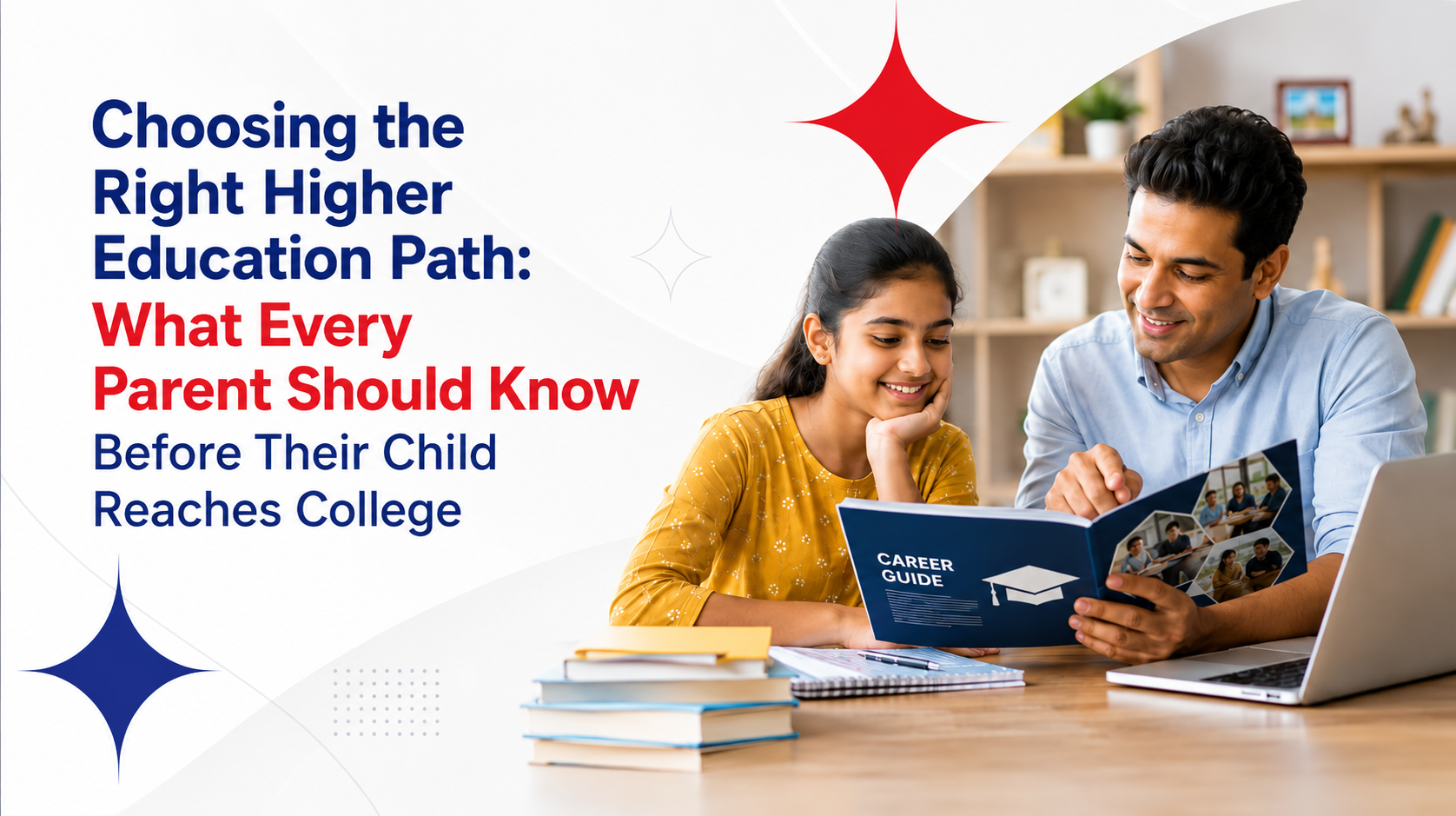
Choosing the Right Higher Education Path begins long before your child submits college applications.
Every parent dreams of seeing their child graduate from a good college and build a successful career. But in today’s fast-changing world, the definition of a “good education” is evolving. A few years ago, getting admission to a reputed college was considered the ultimate goal. Today, it’s only the beginning of a much bigger journey.
Technology, Artificial Intelligence (AI), and changing industry demands are reshaping the skills employers look for. Colleges are adapting their teaching methods, introducing flexible learning pathways, and placing greater emphasis on practical experience. For parents, this shift can feel overwhelming.
The good news is that preparing your child for higher education doesn’t start in Class 11 or 12—it starts much earlier. It begins with building the right mindset, encouraging curiosity, and helping children develop the skills they will need for lifelong success.
Higher Education Is Growing—But Quality Matters More Than Ever
India is witnessing a major transformation in higher education. Under the National Education Policy (NEP) 2020, the country aims to increase the Gross Enrolment Ratio (GER) in higher education from 28.4% to 50% by 2035. This means millions more students will have access to colleges and universities over the next decade.
More institutions, flexible learning options, online courses, and multidisciplinary programs are making higher education more accessible than ever before.
However, access alone is not enough.
Parents should ask an important question: Will my child be ready to succeed after college?
The true value of higher education lies not just in earning a degree but in developing the knowledge, confidence, and skills to thrive in a competitive world.
A Degree Is Important, but Skills Make the Difference
There was a time when a college degree almost guaranteed a stable job. Today, employers expect much more than academic qualifications.
They look for graduates who can think critically, solve problems, communicate effectively, work in teams, adapt to new technologies, and continue learning throughout their careers.
This is why conversations around education are changing. Instead of asking, “Which degree should my child pursue?” parents are increasingly asking, “What skills will help my child succeed in any career?”
Strong academic knowledge remains essential, but it becomes far more valuable when combined with practical skills and the confidence to apply learning in real-life situations.
Colleges Are Becoming More Career-Focused
One of the biggest changes in higher education is the growing emphasis on real-world learning.
Today’s colleges are creating opportunities for students to work on live projects, participate in internships, collaborate with startups, conduct research, and solve real-life business challenges. These experiences help students bridge the gap between classroom learning and industry expectations.
As a parent, it is worth looking beyond rankings and considering whether a college provides meaningful exposure that prepares students for the workplace.
Flexibility Opens New Opportunities
Every child has unique interests and strengths. Recognising this, NEP 2020 encourages a more flexible approach to higher education.
Students now have the freedom to explore multidisciplinary learning, choose electives from different subjects, and benefit from initiatives like the Academic Bank of Credits (ABC), which allows them to earn and transfer academic credits across recognised institutions.
This flexibility enables students to build personalised learning journeys. For instance, a commerce student can study digital marketing or data analytics, while an engineering student can explore entrepreneurship or design thinking.
Such combinations reflect the modern workplace, where innovation often happens at the intersection of different disciplines.
Employability Is the New Benchmark
While parents naturally aspire for their children to graduate from reputed institutions, employability is becoming the real measure of educational success.
Colleges are increasingly evaluated not only on academic performance but also on how effectively they prepare students for careers. Frameworks like NAAC’s outcome-based accreditation and NIRF rankings, which include placement-related indicators, encourage institutions to focus on student outcomes.
However, employability does not begin in college. It starts much earlier through the gradual development of communication skills, critical thinking, collaboration, adaptability, and resilience.
These are abilities that children build over time through classroom experiences, extracurricular activities, and everyday interactions.
How Parents Can Prepare Children for Higher Education
The journey to college starts long before admission applications. Parents play a vital role in helping children develop habits and attitudes that support future success.
Here are a few simple ways to make a meaningful difference:
- Encourage curiosity by welcoming questions and discussions.
- Focus on understanding concepts instead of memorising answers.
- Motivate children to participate in sports, arts, coding, debates, and science exhibitions.
- Help them build confidence in expressing their ideas.
- Encourage regular reading beyond school textbooks.
- Teach responsibility, time management, and problem-solving.
- Introduce them to a variety of career options instead of limiting discussions to traditional professions.
These experiences help children become confident, independent learners who are better prepared for higher education and life beyond.
Choosing the Right School Makes All the Difference
A child’s preparation for higher education begins with the school they attend.
While academic excellence is important, the best schools also focus on developing essential life skills. They encourage students to think independently, collaborate with others, embrace technology, and discover their individual talents.
When evaluating a school, parents should consider whether it:
- Promotes conceptual understanding over rote learning.
- Encourages experiential and project-based learning.
- Integrates technology meaningfully into education.
- Provides opportunities in STEM, sports, arts, and leadership.
- Supports emotional well-being and confidence building.
- Inspires curiosity and a lifelong love for learning.
A balanced education helps students adapt to changing opportunities and prepares them to excel in higher education as well as future careers.
How Radcliffe School Prepares Students for the Future
At Radcliffe School, education is designed to prepare students not only for examinations but also for the opportunities and challenges of tomorrow.
The school nurtures curiosity, confidence, and independent thinking through experiential learning, technology-enabled classrooms, co-curricular activities, and leadership opportunities. Students are encouraged to explore, innovate, collaborate, and grow into well-rounded individuals.
Aligned with the vision of NEP 2020, Radcliffe School focuses on creating future-ready learners equipped with the academic foundation, practical skills, and values needed to succeed in higher education and beyond.
Final Thoughts
The future of higher education is about much more than increasing the number of colleges or admissions. It is about preparing students to contribute meaningfully in a world driven by innovation, technology, and continuous learning.
As a parent, the most valuable investment you can make is helping your child develop curiosity, resilience, confidence, and a love for learning. These qualities will serve them far beyond classrooms and college campuses.
Choosing a school that supports holistic development is the first step in that journey. At Radcliffe School, we believe education should empower every child not just to earn a degree, but to build a fulfilling future, adapt to change, and become a lifelong learner.