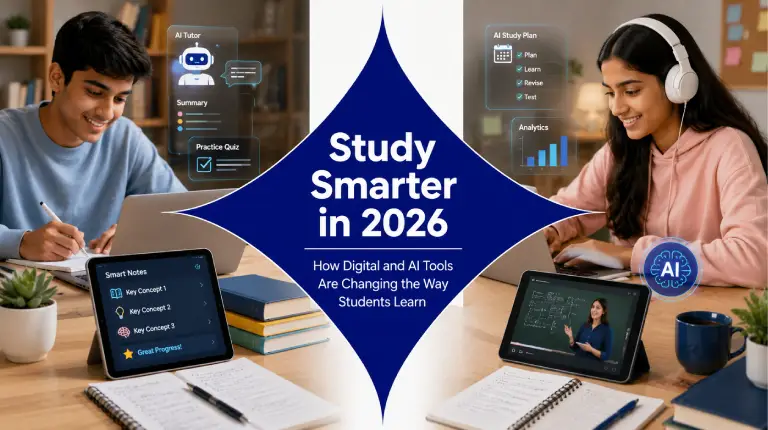
There was a time when studying meant long hours with textbooks, handwritten notes, and waiting for the next class to clear doubts. That world still exists, but it has evolved. Today, students have access to tools that can explain, test, and even personalise learning in ways that were not possible before.
Yet, one thing has not changed. Simply having access to tools does not guarantee better marks. What matters is how thoughtfully they are used.
At institutions like Radcliffe Schools, the focus is not just on introducing students to digital platforms, but on helping them build a structured approach to learning. Because in the end, discipline and clarity still matter more than convenience.
Understanding Digital Learning Beyond the Buzzwords
Digital learning tools are often described as apps or platforms, but for a student, they are better understood as support systems. Some explain difficult concepts, some test understanding, and others simply help organise time.
The real value lies in how they complement traditional study methods rather than replace them. A well-explained video can simplify a concept that felt confusing in class. A quick quiz can reveal gaps that might otherwise go unnoticed. A planner can turn a chaotic study routine into something predictable and manageable.
Instead of trying to use everything at once, students benefit more from choosing a few tools that genuinely help them stay consistent.
Best CBSE School in India Approach: Structure Over Overload
At the Best CBSE School in India, the idea is not to overload students with resources but to guide them towards using the right ones effectively. A student who understands one concept deeply will always outperform someone who has skimmed through many.
Before adopting any tool, students are encouraged to think practically. Does this help me understand better? Can I test myself after using it? Does it align with what I am studying in school?
These small questions prevent distraction and keep learning purposeful.
Where Digital Tools Actually Make a Difference
One of the biggest advantages of digital learning is that it adapts to the student. Not every learner moves at the same pace, and that is where technology quietly fills the gap. When a student struggles, many platforms offer additional practice without judgment. When they improve, the level increases automatically.
Another shift is the speed of feedback. Earlier, mistakes stayed unnoticed until the next test. Now, students can see exactly where they went wrong within seconds. This short feedback loop makes learning more active and less frustrating.
Visual learning has also changed the way difficult subjects are understood. Concepts that once required imagination can now be seen in motion through animations and diagrams. For many students, this makes the difference between memorising and actually understanding.
Time management, often overlooked, becomes easier with simple digital planners. Instead of feeling overwhelmed before exams, students who plan in advance tend to feel more in control.
A Simple Way to Use Digital Tools Without Getting Distracted
Many students start using digital tools with enthusiasm but lose focus along the way. The problem is not the tools. It is the lack of a clear system.
A simple four-step cycle works well in practice. Start by deciding exactly what topic you want to study. Then revisit the concept through notes or a short explanation. Follow this with practice, whether through questions or flashcards. Finally, take a moment to reflect on what went right and what needs improvement.
This cycle does not take extra time, but it brings clarity to every study session.
Where AI Fits Into All of This
Artificial Intelligence has added a new layer to learning. It can explain concepts, summarise chapters, suggest ideas, and even help structure answers. For students, it often feels like having a tutor available at any time.
But there is a subtle difference between using AI well and relying on it too much. When used thoughtfully, it saves time and reduces confusion. When overused, it can reduce the effort a student puts into thinking independently.
At the Best CBSE School in India, students are encouraged to use AI as a support system. It should help them understand better, not replace the process of learning.
Comparing Study Tools and Their Real Impact
| Type of Tool | What It Helps With | When to Use It | Real Benefit |
|---|---|---|---|
| Concept Videos | Understanding difficult topics | When a chapter feels confusing | Builds clarity quickly |
| Quiz-Based Apps | Self-testing | After completing a topic | Identifies mistakes instantly |
| Flashcards | Memorisation | During revision | Improves recall over time |
| Digital Planners | Time management | At the start of the week | Creates consistency |
| AI Tools | Explanation and idea generation | When stuck or brainstorming | Saves time and reduces stress |
The Human Side of Learning Still Matters
With so much technology around, it is easy to assume that tools are doing the heavy lifting. In reality, the student’s mindset plays a much bigger role.
A student who reviews mistakes regularly will improve faster than one who avoids them. Someone who studies with a clear plan will feel less pressure than someone who studies randomly. These habits cannot be replaced by any tool.
Technology can guide the process, but effort and consistency drive the outcome.
How Radcliffe Schools Prepares Students Differently
What sets institutions apart today is not just academic results, but how they prepare students for the future.
As the Best CBSE School in India – Radcliffe School, the focus goes beyond textbooks. The learning environment blends strong academic foundations with exposure to global frameworks like Cambridge and IB. This combination helps students think beyond exams and approach problems with a broader perspective.
Through RadSPARK, students are encouraged to question, explore, and build confidence in their abilities. The emphasis is not just on marks, but on developing curiosity, resilience, and communication skills.
Sports and performing arts are not treated as extras. They are seen as essential parts of growth, helping students build discipline and self-expression alongside academics.
Finding the Right Balance in 2026
The conversation around studying has clearly changed. It is no longer about how many hours a student spends with books, but how effectively that time is used.
Digital tools and AI have made learning faster and more accessible. But they work best when paired with simple habits like planning, practising, and reflecting.
Students who find this balance tend to feel more confident, less stressed, and better prepared. Not just for exams, but for the challenges beyond them.
In the end, success in academics still comes down to something very simple. Understanding what you study, practising it regularly, and learning from your mistakes. Everything else is just support.