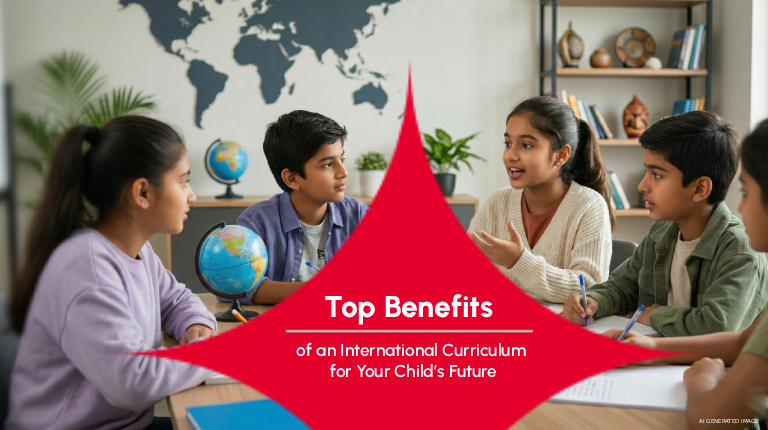
In today’s fast-changing world, education is no longer limited to textbooks, exams, and grades. Parents are increasingly looking beyond traditional learning systems to find an environment that nurtures curiosity, builds confidence, and prepares children for a truly global future. This is where an international curriculum stands out.
Designed around skill development, conceptual understanding, and strong character building, international programs move beyond rote learning to prepare children for life in a dynamic, interconnected world.
So, what makes an international curriculum such a powerful foundation for your child’s future? Let’s explore the key benefits.
1. Skill Development for the 21st Century
An international curriculum focuses on developing essential life skills such as critical thinking, communication, collaboration, creativity, and problem-solving.
Instead of memorizing information, students learn how to analyze, question, interpret, and apply knowledge. These transferable skills equip children to adapt confidently to higher education and future careers—where innovation and adaptability matter more than recall.
2. Deep Conceptual Understanding
Rather than teaching isolated facts, international programes emphasize big ideas and underlying concepts. Students explore why things happen, not just what happens.
This approach helps learners connect knowledge across subjects, making learning meaningful and long-lasting. When children understand concepts deeply, they can apply their learning to unfamiliar situations—an ability that truly prepares them for real-world challenges.
3. Inquiry-Led Learning
Students are encouraged to ask questions, investigate ideas, and explore multiple perspectives. Teachers act as facilitators, guiding learners through structured inquiry and discussion.
This cultivates independent thinking, research skills, and intellectual curiosity. Children grow into confident learners who take ownership of their education rather than passively receiving information.
4. Character and Values Education
An international curriculum recognises that education is not only about academic success—it is about shaping responsible, ethical individuals.
Students develop qualities such as integrity, empathy, resilience, open-mindedness, and respect for others. These values build strong character and emotional intelligence, helping children navigate relationships, leadership roles, and social responsibilities with confidence.
5. Interdisciplinary Learning That Reflects Real Life
In the real world, challenges are not divided into subjects. International programmes integrate learning across disciplines, helping students see connections between science, mathematics, humanities, and the arts.
This interdisciplinary approach encourages practical application of knowledge and prepares children to think holistically when solving complex problems.
6. Global Perspective and Cultural Awareness
Exposure to diverse cultures, global issues, and multiple viewpoints fosters open-mindedness and international awareness. Students develop respect for diversity and gain the confidence to engage in a multicultural world.
This global outlook broadens opportunities for higher education and careers across borders while nurturing socially responsible citizens.
7. Strong Research and Independent Learning Skills
From an early stage, students are gradually introduced to research-based tasks, project work, presentations, and reflective thinking.
They learn how to manage time, organize information, present arguments logically, and evaluate their own progress. These abilities are highly valued by universities and employers worldwide.
8. Focus on Holistic Development
Academic learning is balanced with creativity, physical development, collaboration, and community engagement.
Students participate in activities that build leadership, teamwork, and social responsibility. This balanced development ensures children grow into confident, well-rounded individuals—prepared not just for exams, but for life.
9. A Positive and Supportive Learning Environment
International schools often prioritise student well-being and agency. Children are encouraged to express ideas, reflect on their learning, and take ownership of their growth.
When students feel safe, valued, and supported, they become motivated learners who embrace challenges with confidence.
Why Choose Radcliffe for IB Education in Bangalore?
Radcliffe brings together the global strength of the IB and Cambridge curricula with a strong child-centric philosophy. With experienced educators, personalized attention, and a future-focused learning environment, Radcliffe ensures that every child’s potential is nurtured.
For families exploring IB and Cambridge schools in Bannerghatta Road or trusted international schools in Bangalore, Radcliffe offers an education that is meaningful, balanced, and globally relevant.
Why This Matters for Your Child’s Future
Choosing an international curriculum means choosing an education that builds competence, character, and global awareness. It prepares children not only for university admission but for meaningful participation in an ever-evolving world.
If you are seeking an educational pathway that nurtures skill development, conceptual clarity, and strong values, an international curriculum offers a future-ready foundation for your child’s academic journey and personal growth.
Ready to give your child a future-ready education?
Explore how the international curriculum at Radcliffe in Bangalore can shape your child’s academic journey and personal growth. Schedule a campus visit or speak to our admissions team today.