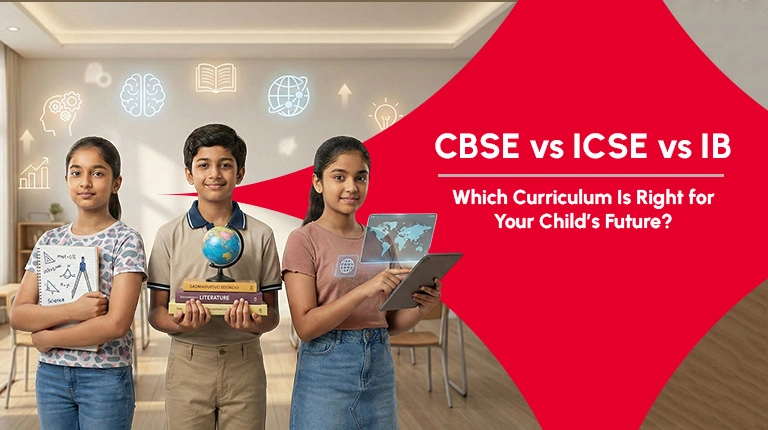
Choosing the right curriculum is one of the most important decisions parents make for their child. Beyond textbooks and examinations, parents today look for clarity, consistency, skill development, and future readiness. With boards like CBSE, ICSE, and IB offering different learning philosophies, it becomes essential to understand how each one aligns with what parents expect from a school and how it supports a child’s long-term academic journey.
This comprehensive comparison helps parents evaluate which curriculum best suits their child’s needs, learning pace, and future aspirations.
Understanding the Learning Approach of Each Curriculum
CBSE: Structured, Concept-Based, and Nationally Aligned
Many parents consider CBSE because they value a well-defined academic structure, clarity in concepts, and continuity across grades. The CBSE curriculum is designed to build strong fundamentals, especially in Mathematics and Science, while maintaining consistency in assessment and learning outcomes.
Parents exploring the top CBSE schools in India often look for schools that offer a balanced academic environment, manageable learning progression, and preparation aligned with national-level competitive exams. Similarly, families searching for the best CBSE schools in India usually expect clear learning objectives, regular evaluations, and teaching methods that focus on understanding rather than rote memorisation.
At a CBSE school like Radcliffe School, this parental expectation is addressed through structured lesson planning, concept-based teaching, and age-appropriate academic pacing. The focus remains on helping children build strong foundations while keeping learning engaging and stress-managed, which is why CBSE schools in India continue to be a preferred choice for many families.
ICSE: Detailed Curriculum and Language-Focused Learning
Parents who consider ICSE are often drawn to its detailed syllabus and strong emphasis on language development. The curriculum encourages in-depth understanding across subjects, with particular attention to English, literature, and expressive skills.
This board appeals to families who value comprehensive subject exposure and believe that strong communication and analytical abilities play a key role in future academic and professional success. ICSE’s approach supports children who enjoy reading, writing, and exploring subjects in greater detail.
IB: Global Outlook and Inquiry-Based Education
Parents choosing IB are typically looking for a curriculum that goes beyond traditional academics. The IB framework focuses on inquiry, research, and real-world application, making it attractive for families seeking global exposure and skill-driven education.
The IB Primary Years Programme (PYP), designed for younger learners, supports curiosity, creativity, and independent thinking from an early age. Through projects, collaboration, and experiential learning, IB helps children develop problem-solving skills, communication abilities, and global awareness.
IB curriculum benefits also include flexibility in learning pathways and a strong emphasis on personal development alongside academics, which resonates with parents planning international higher education options.
Comparing CBSE, ICSE, and IB at a Glance
1. Teaching Style and Assessment
CBSE follows a structured and predictable assessment system that many parents appreciate for its clarity and consistency.
ICSE offers a balanced evaluation approach with detailed subject coverage.
IB uses continuous, project-based assessments focused on holistic development.
2. Subject Flexibility
CBSE and ICSE provide defined subject combinations, offering stability and academic direction.
IB allows greater flexibility, enabling children to explore subjects based on interest and aptitude.
3. Recognition and Future Readiness
CBSE aligns well with national examinations and higher education pathways in India.
ICSE supports strong academic depth and language proficiency.
IB is globally recognised for nurturing research skills, critical thinking, and communication.
Which Curriculum Ensures Better Outcomes?
There is no single curriculum that guarantees success for every child. Parents often find that the best outcomes come when the curriculum matches their child’s learning style, and the school’s teaching approach supports consistent growth.
CBSE is commonly chosen by parents who want structured learning, conceptual clarity, and academic continuity.
ICSE appeals to families who prioritise detailed learning and strong language skills.
IB attracts parents seeking global exposure, flexible learning, and skill-based education.
Ultimately, the effectiveness of any curriculum depends on how well it is delivered and how closely it aligns with a child’s individual needs.
Factors to Consider Before Choosing a Curriculum
Parents evaluating CBSE, ICSE, or IB often reflect on the learning environment their child is comfortable in, the balance between structure and exploration, future academic plans, and their child’s interest in collaborative or independent learning. Aligning these factors with the school’s philosophy helps ensure a positive and rewarding educational experience.
Why Radcliffe Offers Both CBSE and IB
Radcliffe understands that parents look for choice, flexibility, and clarity when selecting a curriculum. Recognising that every child learns differently, Radcliffe offers both CBSE and IB to support diverse learning needs.
The CBSE programme at Radcliffe focuses on strong academic foundations, conceptual understanding, and structured progression.
The IB programme at Radcliffe emphasises inquiry, creativity, communication, and global perspectives.
By offering both curricula, Radcliffe enables parents to choose a pathway that aligns with their child’s strengths, learning style, and long-term goals.
Early Learning at Radcliffe: Where Curiosity Begins
At the early years level, Radcliffe integrates the IB Primary Years Programme with a strong academic framework to create a nurturing learning environment. Children benefit from personalised attention, activity-based learning, and technology-supported classrooms that make learning meaningful and engaging.
This approach helps young learners build confidence, curiosity, and a love for learning that continues throughout their academic journey.
Conclusion: Choosing the Best Curriculum for Your Child
Whether parents prefer the structured consistency of CBSE, the academic depth of ICSE, or the global outlook of IB, the right curriculum is one that supports a child’s growth academically, emotionally, and creatively. By offering both CBSE and IB, Radcliffe gives families the flexibility to choose an educational path that aligns with their child’s future aspirations.
The ultimate goal remains the same: nurturing confident, capable, and future-ready learners through thoughtful curriculum choices and a supportive school environment.
FAQs
1. Which curriculum is better for my child—CBSE, ICSE, or IB?
Each curriculum has its own advantages. CBSE offers structured learning and concept clarity, ICSE provides detailed subject depth and strong language skills, and IB focuses on inquiry, global exposure, and skill development. The best choice depends on your child’s interests and learning style.
2. Is CBSE a good option for higher studies in India?
Yes. CBSE aligns well with national entrance exams and Indian university requirements. Its structured framework helps students build strong fundamentals in science, mathematics, and social studies.
3. How is IB different from CBSE and ICSE?
IB is inquiry-driven and encourages independent thinking, research, reflection, and real-world learning. CBSE and ICSE are more structured and content-focused, whereas IB fosters global perspectives and interdisciplinary understanding.
4. Is ICSE suitable for students who like languages and writing?
Definitely. ICSE places strong emphasis on English language development, creative writing, and analytical skills. It is a great choice for students who enjoy literature, reading, and expressive learning.
5. Why does Radcliffe offer both CBSE and IB?
Radcliffe recognises that children learn differently. By offering both CBSE and IB, the school provides two strong pathways—CBSE for conceptual clarity and structured academics, and IB for creativity, inquiry, and global thinking. Radcliffe also offers the IB curriculum at its IB School in Bangalore, giving parents in the city access to globally benchmarked, inquiry-driven education.
6. What is the right age for the IB Primary Years Programme?
The IB PYP is designed for children aged 3 to 12. It nurtures curiosity, creativity, early cognition, and emotional development through activity-based, transdisciplinary learning.
8. Is IB too difficult for young children?
Not at all. The IB PYP is designed to be child-friendly. It focuses on exploration, hands-on learning, curiosity, and self-expression. The aim is to nurture independent thinkers, not overwhelm them.